

Male hair loss is a widespread issue affecting millions of men globally. One question many men have about hair loss is why some men retain an abundant head of hair until they reach the ages of sixty and older while other men show evidence of thinning hair in their twenties. The reason for these differences often lies in genetics, hormones and the degree of male pattern baldness as defined by the Norwood Scale.
The Norwood Scale is the most popularly utilized method for classifying male hair loss. Specialists utilizing the Norwood Scale are able to analyze the degree of baldness, forecast what will occur during the future, and develop personalized treatment recommendations for their patients. Patients who understand which level of the Norwood Scale they fit in will better be equipped to take steps toward preserving their own hair and planning for long-term hair restoration.
What is the Norwood scale?
The Norwood-Hamilton classification system explained
What is the Norwood Scale?
The Norwood Scale, also referred to as the Norwood-Hamilton Classification System, was created by Dr. O’Tar Norwood as a means of measuring the advancement of male pattern baldness. The Norwood Scale categorizes male pattern baldness into seven major levels.
Today, hair restoration surgeons, dermatologists, and hair restoration specialists worldwide utilize the Norwood Scale to evaluate the extent of baldness and create custom treatment plans for their patients.
Why Is the Norwood scale useful?
The Norwood Scale enables professionals to:
- Measure the advancement of hair loss
- Determine a patient’s potential for future hair loss
- Design hair transplant surgical procedures
- Assess the efficacy of treatments
- Establish realistic expectations
In addition to providing professionals with a basis upon which to work, patients receive greater clarity regarding their situation and possible alternatives.
What makes baldness progress over time?
Why do men lose hair as they get older?
Many patients inquire as to why hair loss becomes more obvious as they grow older.
Androgenetic alopecia, commonly referred to as male pattern baldness, is the primary reason why men lose their hair as they age. Androgenetic alopecia is a hereditary condition that impacts genetically predisposed hair follicles that become progressively responsive to a hormone called dihydrotestosterone (DHT).
As DHT influences the shrinking of hair follicles, it causes smaller, less dense hairs to grow, leading to progressive thinning of the scalp.
How does DHT impact hair follicles?
DHT plays a role in:
- Decreasing the size of follicles
- Limiting the duration of each growth cycle
- Lessening the number of hairs per unit area
- Increasing thinning
- Causing inactive follicles
Due to these effects, hair loss normally progresses gradually over a period of numerous years.
Can any additional variables increase hair loss?
While genetics are generally responsible for the majority of cases, there are a variety of variables that can lead to increased rates of progression:
- Smoking
- Ongoing stressful situations
- Suboptimal nutrition
- Imbalanced hormone levels
- Specific medical conditions
- Subpar scalp health
Maintaining optimal physical health can potentially aid in supporting general hair health.
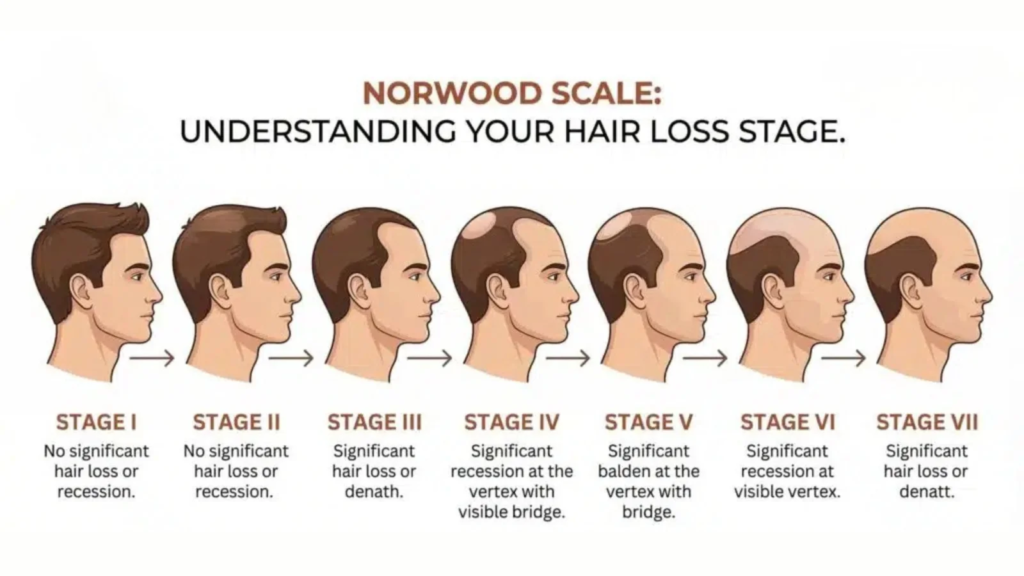
Stage 1: Little to no hair loss on the Norwood scale
What does Norwood 1 look like?
Norwood Stage 1 indicates almost no noticeable hair loss.
Men at this stage typically exhibit:
- An intact hairline
- Uniform density on the scalp
- No notable recession on either side
Most men in their late teens and early twenties fit into this category.
Is treatment required?
Generally speaking, treatment is unnecessary. However, those with a considerable family history of baldness could benefit from ongoing monitoring and employing preventive measures early.
Stage 2: Initial temple recession
Where does hair loss begin?
Upon reaching Norwood Stage 2, minor recession starts becoming apparent along the temples.
This stage produces the illusion of an adult hairline instead of substantial hair loss.
Common characteristics of stage 2
Patients tend to observe:
- Minor temple recession
- M-shape formation in the hairline
- Frontal density remaining relatively stable
Can hair loss be delayed?
Yes. When early action is taken, this tends to produce the greatest success over the course of many years.
- Finasteride
- Minoxidil
- Platelet rich plasma therapy (PRP)
- Dietary support
Stage 3: Obvious hair loss
When does hair loss become more apparent?
Norwood Stage 3 is viewed as the initial stage of substantial baldness.
At this juncture, receding temples become much more evident and may start influencing feelings of confidence and self-esteem.
Indicators of stage 3 hair loss
Typical traits associated with this stage involve:
- Increased temple recession
- Clear indications of a changing hairline
- Reduced frontal density
Do restorative treatments work effectively?
Without exception.
Numerous patients obtain very favorable results via:
- Medical therapy
- PRP treatments
- Hair transplants
Also, earlier interventions may allow for preservation of current natural hair for longer periods.
Stage 4: Frontal recession and crown thinning
What Happens at Stage 4?
During Norwood Stage 4, hair loss advances past the temples and frequently involves the crown.
There is usually a prominent bare spot located atop the vertex.
Common characteristics of stage 4
- Noticeably larger amounts of forehead recession exist
- Crown thinning has begun
- Reduced density above the top portion of the scalp
Will surgical hair transplantation be recommended?
For many patients, yes.
Hair transplant procedures are now becoming far more prevalent at this stage since both the hairline and crown may need restored.
Stage 5: Increased areas of baldness
How does baldness continue developing?
By Stage 5, areas of baldness expand and combine.
The bridge of hair between the front and crown narrows dramatically.
Attributes of stage 5
Patients often experience:
- Greater bald regions
- Thin strands of existing hair
- Obvious visibility of the scalp
What treatments are offered?
Typically, treatments include:
- Hair transplantation
- Finasteride
- PRP treatments
- Maintenance program
Since early treatment offers superior benefits, all efforts should be directed towards this goal.
Stage 6: Large areas of baldness
What does stage 6 appear as?
On the Norwood Scale, at Stage 6, the bald areas front and crown connect together forming one large bald patch.
There is significantly diminished thickness of existing hair on top of the scalp.
Identifiable characteristics
- Large surface area exposed on the scalp
- Much reduced density on the top scalp
- Expansion on the crown area
Can hair restoration still aid?
Yes.
Regardless of diminished availability of donor hairs in later stages, skilled surgeons continue to offer outstanding results with:
- Hair transplant operations
- Scalp micropigmentation
- Combinations for restoration
Though availability of donor hairs is lower in later stages, many surgeons provide exceptionally successful improvements for their patients.
Stage 7: Extreme amount of baldness
What represents the last level in the Norwood classification system?
Norwood Stage 7 denotes an extreme amount of male pattern baldness.
Only a small strip of remaining hair exists around the perimeter, including the sides and back of the scalp.
Features common to stage 7
- Extreme amounts of total balding
- Small sections covering the scalp
- Limited reserve for donor hairs
What alternatives are available now?
Potential alternatives for this final stage may include:
- Selective hair transplantations
- Donor body hair grafts
- Scalp micropigmentation
- Wigs or hair systems
With limitations in available donor hairs and varying degrees of expectation among patients for each treatment option, every treatment option must be individually tailored according to available donor hair and personal expectations.

How rapidly will baldness advance?
Does each person experience the same rate of change?
No.
The rate of progression varies greatly between different men.
Some men may remain at Stage 2 for decades while others may progress from Stage 2 to Stage 5 in just a few years.
Variables that influence the rate of progression
Multiple variables determine how quickly a man loses his hair.
- Genetics
- Levels of hormones present
- Chronological age
- Behavioral patterns and lifestyle choices
- General health status
Understanding these factors can help patients establish realistic expectations regarding future hair loss progression and treatment outcomes.
Advanced stages of male pattern baldness (Norwood 6–7)
What are the treatment possibilities?
There may be some other possibilities for these stages including:
- Advanced hair restoration surgery
- Scalp micropigmentation
- Hair replacement systems
These will depend on each patient’s personal preferences and whether they have enough available hair from their donor area.
Summary
While the Norwood Scale is still used as an indicator for how and when hair loss occurs with age, it helps us establish where we are at with our hair loss and what we might expect for our own unique hair loss experience.
With many modern hair restoration treatments currently being offered, there are numerous options that allow individuals to restore, improve and maintain their natural hair density. Early detection of male pattern baldness also creates greater potential for positive results.
Regardless of whether you have minor receding temples or significant hair loss, using the Norwood Scale as an educational tool will help you know how best to proceed with your hair restoration.
Conclusion
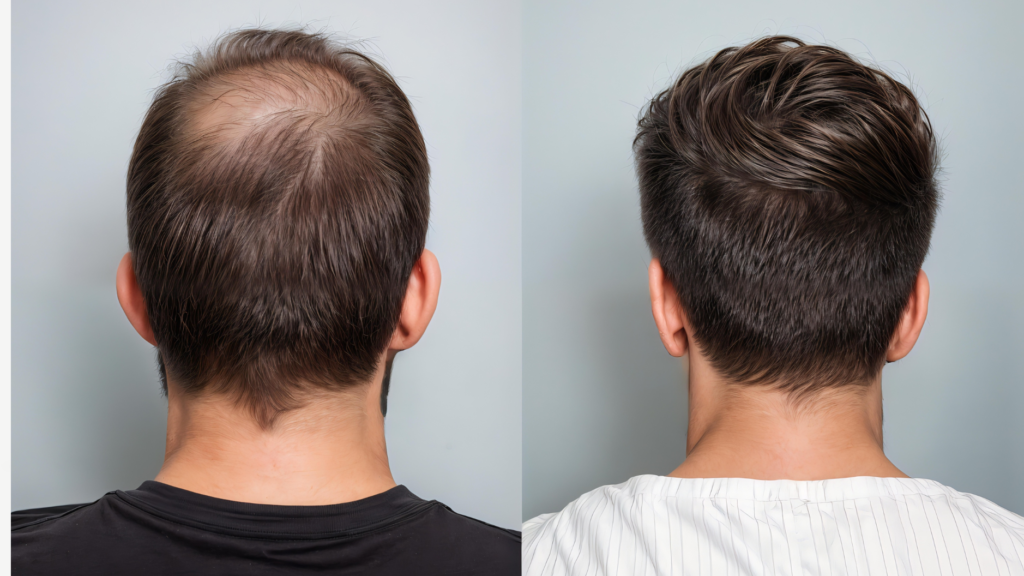
The Norwood Scale remains one of the most valuable tools for understanding how baldness progresses with age. By identifying the stage of hair loss accurately, patients can better understand their condition, establish realistic expectations, and explore the most appropriate treatment options available.
Although male pattern baldness typically becomes more noticeable over time, modern hair restoration treatments continue to provide highly effective solutions for preserving, restoring, and improving hair density. Furthermore, early diagnosis and intervention often offer the greatest opportunity for successful long-term outcomes.
Whether you are experiencing mild temple recession or advanced hair loss, understanding the Norwood Scale can help you make informed decisions about your hair restoration journey. Recognizing your stage of hair loss is often the first step toward finding the most suitable treatment strategy and protecting your hair for years to come.
To learn more about male pattern baldness, hair transplant procedures, and advanced hair restoration treatments, visit Top Hair Loss Clinic and schedule a consultation with an experienced hair restoration specialist.