

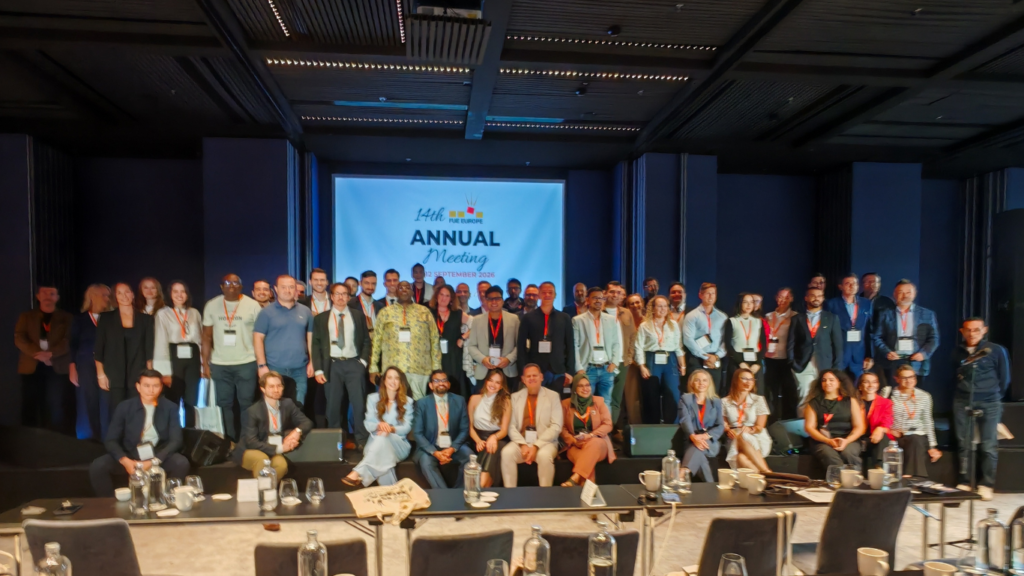
TopHairLossClinic.com attended FUE Europe 2026 in Warsaw, where our CEO, Peggy Stavrianou, joined an international faculty of hair transplant surgeons, researchers and patient advocates to discuss the future of hair restoration — from advanced FUE and complex repair cases to regenerative medicine, artificial intelligence and the changing expectations of today’s patients.
From 10–12 September 2026, specialists from around the world gathered in Warsaw, Poland, for the 14th Annual Meeting of FUE Europe. The three-day programme moved from diagnosis, trichoscopy and medical therapy to surgical science, complex cases, live surgery and practical educational workshops.
For TopHairLossClinic, however, this was more than an opportunity to attend an industry meeting.
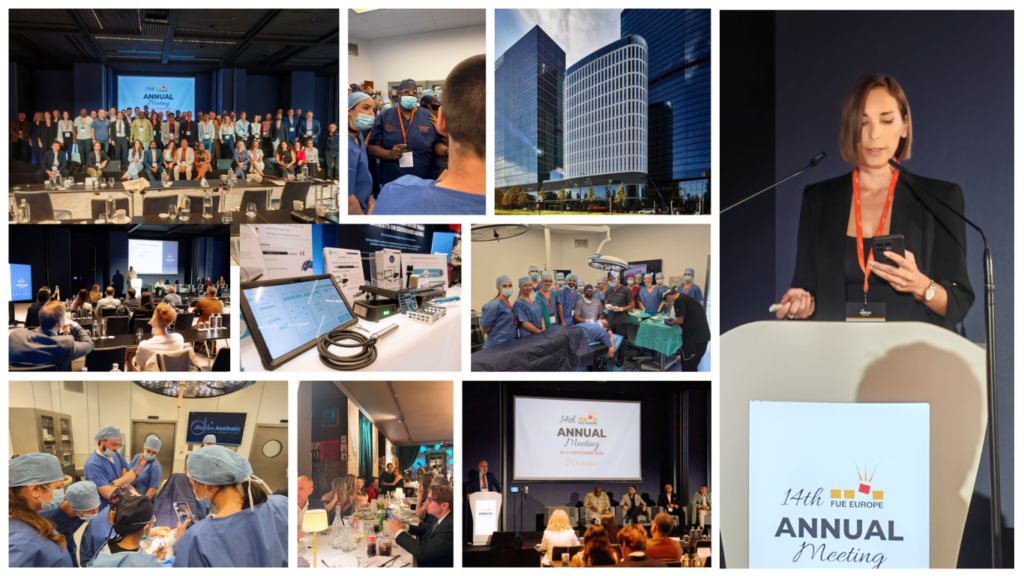
Our CEO, Peggy Stavrianou, was invited to take the stage as a speaker at FUE Europe 2026, bringing the patient and medical-tourism perspective to a congress traditionally centred on surgical and scientific expertise.
From Zarev and Feriduni to Bicer, Erdogan and Bisanga
One of the most interesting aspects of FUE Europe 2026 was the breadth of expertise brought together under one roof.
The programme included internationally recognised names in hair restoration such as Dr. Tsvetalin Zarev, Dr. Bijan Feriduni, Dr. Özlem Bicer, Dr. Koray Erdogan, Dr. Christian Bisanga, Dr. Anastasios Vekris, Dr. Özgür Öztan, Dr. Tayfun Oguzoglu, Dr. Jean Devroye and many other physicians and specialists from Europe and around the world.
Rather than focusing on a single technique, the meeting explored some of the most important questions facing modern hair restoration.
On the surgical programme, Dr. Bijan Feriduni presented the surgical principles behind a great hairline, while Dr. Christian Bisanga addressed recipient-site creation, microhole size and safe density. Dr. Tsvetalin Zarev discussed the planning of mega- and gigasessions, and Dr. Koray Erdogan presented the growing role of artificial intelligence in hair transplantation, including AI-based tools for analysing coverage.
This combination is significant because the conversation around hair transplantation is increasingly moving beyond a simple question of “How many grafts can be transplanted?”
The modern discussion is about diagnosis, donor management, surgical planning, hairline design, density, long-term treatment and how technology can help doctors make better-informed decisions.
Repair Surgery: An Increasingly Important Part of Hair Restoration
Another important focus of the congress was repair.
As the global hair transplant market has expanded, experienced surgeons are increasingly seeing patients seeking correction of previous procedures.
The FUE Europe programme dedicated a session specifically to repair surgery, including Dr. Bijan Feriduni presenting repair cases, Dr. Özlem Bicer discussing FUE reconstruction by extraction versus laser hair removal, and Dr. Anastasios Vekris addressing scar restoration.
For patients, this highlights something TopHairLossClinic repeatedly emphasises: a hair transplant should never be planned as an isolated procedure.
The donor area is finite. Hairline decisions made today may affect what is possible ten or twenty years later. Choosing the right doctor, therefore, is not simply about achieving growth — it is about having a long-term strategy for progressive hair loss.
The Conversation Is Expanding Beyond Surgery
FUE Europe also demonstrated how rapidly hair-restoration medicine is evolving outside the operating room.
An extensive regenerative-medicine programme examined subjects including PRP standardisation, polynucleotides, progenitor-cell micrografts, regenerative scalp optimisation, nanofat grafting and the use of regenerative approaches alongside FUE.
Diagnosis and medical management received equally strong attention, with sessions covering trichoscopy, antiandrogens, minoxidil, nutrition, supplements and evidence-based approaches to genetic hair loss.
That distinction matters.
Hair restoration is not synonymous with hair transplantation.
For some patients, surgery may be appropriate. For others, medical treatment or continued monitoring may be the better first step. Accurate diagnosis remains the foundation of responsible treatment planning.
Peggy Stavrianou: “Hair Transplant Tourism — Expectations vs Reality”
One of the themes particularly relevant to TopHairLossClinic came during the congress’s dedicated Patient Perspective session.
TopHairLossClinic CEO Peggy Stavrianou presented:
“Hair Transplant Tourism: Expectations vs Reality”
She shared the session with well-known patient advocates and industry voices including Spencer Stevenson, Joe Tillman, Steven Tait, Nick Weeks, Matt Dominance and David Anderson. Topics ranged from building trust between surgeons and patients to AI, social media, marketing and what patients value when choosing treatment.
Stavrianou’s presentation focused on a fundamental change taking place within the international hair transplant market:
The hair transplant tourist has changed.
Today’s patient often arrives at a consultation after months — sometimes years — of research.
Patients watch procedures on YouTube and TikTok. They compare before-and-after results on Instagram. They read Reddit discussions and specialist forums. They listen to podcasts, study clinic reviews and increasingly use AI tools to research doctors, techniques, risks and expected outcomes.
As a result, patients are becoming younger, more informed, more digitally influenced and more demanding.
But access to more information does not necessarily mean access to better information.
Highly edited before-and-after photographs, influencer marketing, unrealistic graft numbers, aggressive hairlines and price-driven advertising can create expectations that responsible surgeons may not be willing — or medically able — to meet.
That gap between expectation and medical reality was at the centre of the TopHairLossClinic presentation.
When Marketing Moves Faster Than Medicine
Hair transplantation has become an international consumer market.
Patients routinely travel across borders for surgery, comparing countries, clinics, doctors, prices and packages before making a decision.
That accessibility has created enormous opportunities — but also new responsibilities.
A clinic may be able to advertise a dramatic transformation in seconds. A surgeon, however, must think about the patient’s donor capacity, age, pattern of hair loss, hair characteristics, medical history and what may happen decades after the photograph used in an advertisement was taken.
For TopHairLossClinic, one of the most important lessons from Warsaw was therefore simple:
Marketing should never move faster than medicine.
Transparency about who actually performs the surgery, realistic expectations, appropriate patient selection and long-term donor planning should remain central to the decision-making process.
Live Surgery: Moving From Theory to the Operating Room
The final day of FUE Europe moved from presentations to practical education and live surgery at Warsaw Aesthetic Clinic.
The programme included eyebrow transplantation, eyelash surgery, SMP, female Long Hair FUE and manual FUE extraction. A live manual-extraction session brought together Dr. Özgür Öztan, Dr. Bijan Feriduni and Dr. Felix Popescu, while another workshop explored Long Hair FUE with Dr. Tayfun Oguzoglu, Dr. Alejandro Gonzalez, Dr. Anastasios Vekris and Dr. Antonia Andriopoulou.
This practical component reinforced one of the strongest themes running through the meeting: hair restoration continues to become more sophisticated and personalised.
There is no single procedure, graft number or surgical plan that is right for every patient.
What Did We Take Away From FUE Europe 2026?
Perhaps the biggest takeaway from Warsaw was not a particular device or technique.
It was the direction in which the entire field is moving.
Better diagnosis. More individualised planning. Greater attention to donor preservation. More sophisticated repair surgery. Evidence-based regenerative treatments. AI-assisted assessment. And, importantly, a stronger patient voice.
The official programme itself reflected that evolution: Thursday centred on diagnosis, trichoscopy and therapy; Friday moved into surgical science and complex cases; and Saturday was dedicated to live surgery and educational workshops.
Technology will continue to change hair transplantation. AI will change how patients research clinics and how doctors analyse cases. Social media will continue to influence expectations.
But one principle remains remarkably traditional:
The quality of a hair transplant ultimately depends on good diagnosis, responsible planning, surgical skill and trust between doctor and patient.
Why TopHairLossClinic Attends International Hair Restoration Meetings
TopHairLossClinic was created to help patients navigate an industry that can often be difficult to understand from the outside.
Attending meetings such as FUE Europe allows our team to remain connected with surgeons, researchers, patient advocates and emerging developments within hair-restoration medicine.
Being invited not only to attend but to contribute to the scientific programme gives us another opportunity to bring the patient perspective into the same room where new surgical techniques, technologies and treatment approaches are being discussed.
And that is important because the future of hair restoration should not be shaped by surgeons, clinics, technology companies or marketers alone.
Patients need to be part of that conversation too.
For TopHairLossClinic, Warsaw was therefore about much more than attending another congress.
It was an opportunity to listen, learn, challenge ideas, exchange perspectives — and help connect the medical side of hair restoration with the expectations of the people ultimately making one of its most important decisions: the patients.